What Are the Benefits of Pilates? Who Pilates Is Really Good For
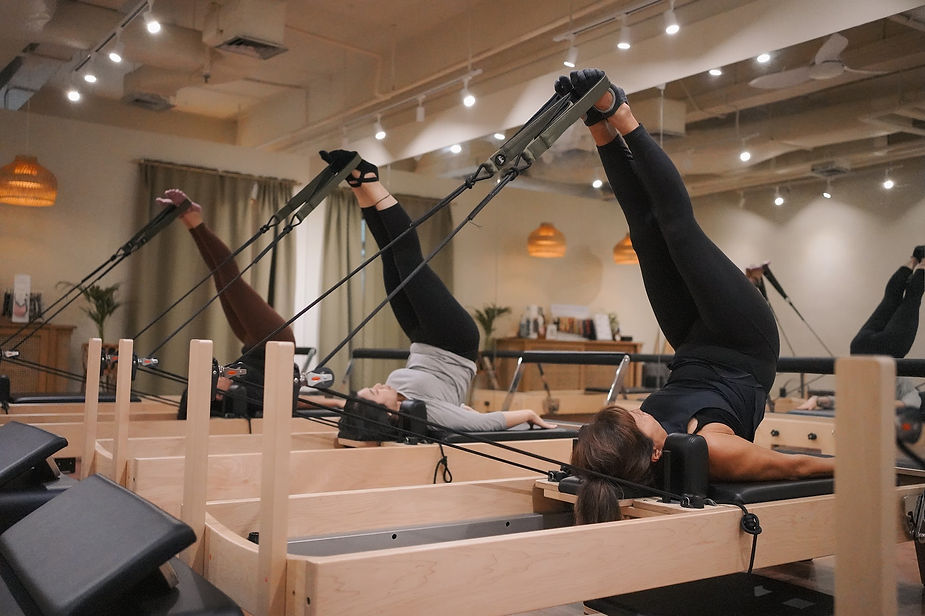
Pilates is more than a workout. From building strength and improving posture to helping you understand how your body moves, here are the benefits of Pilates and who can get the most from it.
Pilates has become one of the most popular ways to exercise in Singapore, but if you have never tried it, you might still be wondering: what does Pilates actually do?
The short answer is that Pilates helps you build strength, mobility, control and a better understanding of how your body moves.
But what makes it particularly useful is that it does not assume every body moves the same way.
Some people come to Pilates because they want to get stronger. Others spend eight hours a day sitting at a desk and feel permanently stiff. Some are returning to movement after having a baby. Others have back pain, scoliosis, old injuries or muscular imbalances that mean a generic workout does not always feel right.
That is where Pilates can really shine.
1. Pilates builds strength without forgetting how you move
Pilates is often associated with the core, and yes, your core will work.
But a good Pilates session is a full-body workout.
Depending on the exercises and equipment used, you might be strengthening your glutes, legs, back, shoulders and arms while simultaneously working on stability and control.
The difference is that the goal is not simply to complete as many repetitions as possible.
You are paying attention to how you move.
Are you loading one leg more than the other? Are your shoulders creeping towards your ears? Are you using your lower back to compensate for something your hips should be doing?
These tiny details matter.
Over time, Pilates helps you build strength with greater awareness of your movement patterns, rather than simply getting better at pushing through them.
2. Pilates is excellent for people who sit at a desk all day
If your working day involves a laptop, a phone and several hours spent in the same chair, you probably already know how your body feels by 6pm.
Tight hips. Stiff shoulders. A cranky lower back. That familiar urge to stretch your neck every twenty minutes.
Pilates gives your body something very different from what it has been doing all day.
You move your spine in different directions. You strengthen the muscles supporting your posture. You work your hips and shoulders through a greater range of movement. Most importantly, you start noticing the habits your body has developed outside the studio too.
For office workers, Pilates can be a useful counterbalance to a very sedentary working day.
3. Pilates can help address muscular imbalances
None of us is perfectly symmetrical.
But certain sports, jobs and habits can create particularly noticeable differences between the two sides of the body.
Golf is a good example. Repeatedly rotating in the same direction can create differences in strength, mobility and control between sides.
The same applies to someone who always carries their child on one hip, consistently crosses the same leg at their desk or has spent years compensating around an old injury.
Pilates gives you an opportunity to slow things down enough to notice those differences.
From there, exercises can be adjusted to improve strength, mobility and control where you need them.
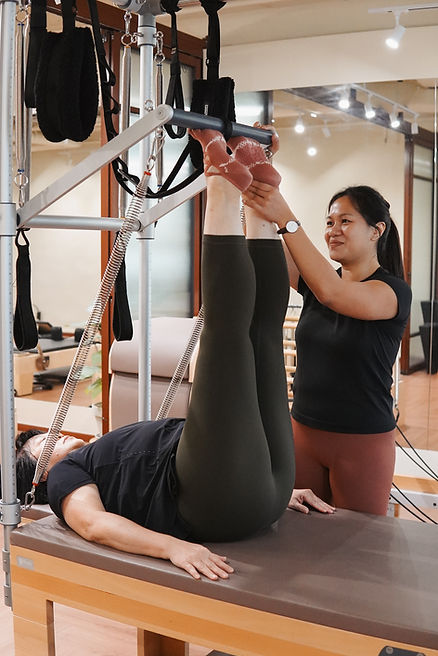
This is one reason Private Pilates can be particularly useful for people with very specific movement goals. Instead of following a general programme, your instructor can work with what is actually happening in your body.
4. Pilates can support better posture
Good posture is not about forcing yourself to sit perfectly straight all day.
It is about having enough strength, mobility and body awareness to support yourself comfortably in different positions.
Pilates works on all three.
Research has found promising evidence for Pilates in improving postural alignment, although outcomes vary depending on the individual and the condition being studied.
For most people, one of the biggest changes is simply awareness.
You start noticing when your ribs are flaring. When your pelvis is tipping forward. When one shoulder sits differently from the other.
And once you can feel something, you have a much better chance of changing it.
5. Pilates can be helpful for people with back pain or scoliosis
Back pain is one of the reasons many people first discover Pilates.
Research suggests Pilates can help improve pain and disability in people with chronic non-specific lower back pain, although it is not necessarily superior to every other form of appropriate exercise.
There is also emerging research around Pilates, posture and scoliosis. The evidence is promising in some areas, but still developing, which is why scoliosis should never be treated as simply another fitness goal.
At The Core Reformery, clients with back pain, scoliosis, injuries or significant movement limitations are better suited to a Private Pilates session rather than jumping straight into a group class.
It gives your instructor time to understand your history, observe how you move and adapt the session accordingly.
Pilates should work with your body, not ask your body to keep up with a room.
6. Pilates is a great way to return to movement after pregnancy
Pregnancy and childbirth can change how your entire body feels.
Your abdominal wall has stretched. Your pelvic floor has been through a lot. Your posture may have changed. You may also be feeding, carrying and rocking a baby for several hours every day.
Returning to exercise does not have to mean immediately returning to the body or workouts you had before pregnancy.
Postnatal Pilates can help rebuild strength progressively, reconnect you with your core and give you space to understand how your body feels now.
And sometimes, that hour of moving and paying attention to yourself matters just as much.
For postnatal clients with specific concerns, we recommend beginning privately so the session can be adapted to your individual recovery and needs.
7. Pilates is for beginners too
You do not need to be flexible.
You do not need a strong core.
You definitely do not need to know what a reformer spring does before you arrive.
Those are things you learn.
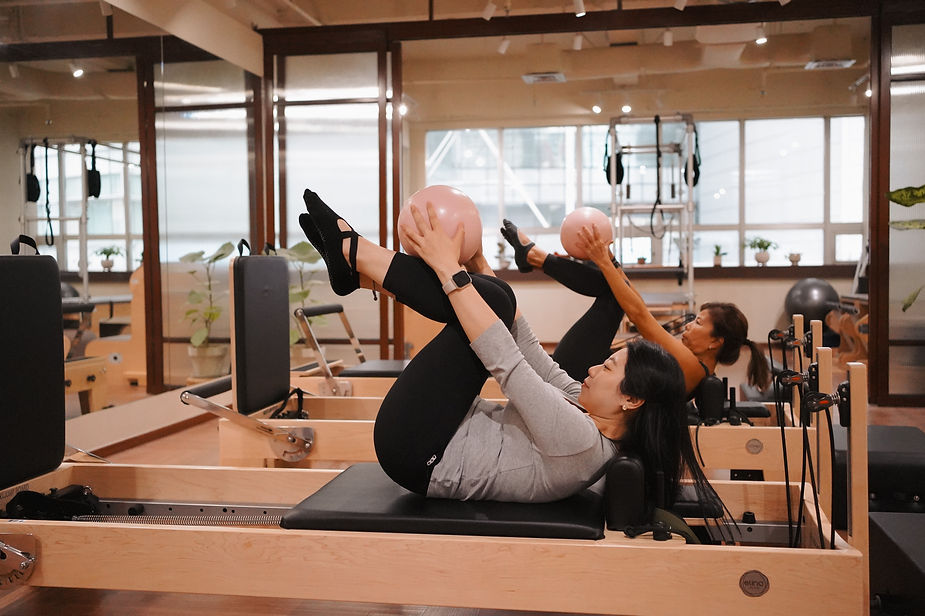
At The Core Reformery, our beginner classes focus on building the foundations first. You learn how to use the equipment, understand the basic Pilates principles and develop enough control and confidence to progress.
If you are completely new, you can read our Guide for First Timers or explore our Group Pilates classes before your first session.
8. And yes, Pilates can still be challenging
Pilates has somehow developed a reputation for being both impossibly difficult and basically stretching.
Neither is particularly accurate.
Pilates can be gentle when it needs to be. It can also be extremely challenging.
As you progress, exercises become more complex. Resistance changes. Stability decreases. Coordination becomes harder. You are expected to control more of your body while relying less on momentum.
The work gets deeper because your understanding gets better.
That means Pilates can grow with you rather than becoming something you simply “complete.”
What makes Pilates at The Core Reformery Pilates Singapore different?
We believe attention changes the way you experience Pilates.
Our classes are intentionally small because we want our instructors to actually see the people they are teaching.
We want to notice when your right hip is doing something different from your left. We want to remember that your shoulder was bothering you last week. We want to know when you are ready for a progression and when you would benefit more from staying exactly where you are.
You should never feel lost in the room.
For clients who need even more individual attention, our private sessions allow us to work completely around your body, goals and pace.
It is Pilates that feels personal, precise and intentional.
So, who is Pilates good for?
Pilates can be a great fit if you:
- Spend most of your working day sitting at a desk
- Want to build full-body strength and core control
- Feel stiff and want to improve mobility
- Want to improve your posture and body awareness
- Play sports such as golf and want to work on strength and muscular imbalances
- Are returning to movement after pregnancy
- Have previous injuries, back pain, scoliosis or specific movement concerns and want individual guidance
- Are completely new to exercise and want to build a strong foundation
- Already exercise regularly but want better control, mobility and movement quality
The important part is choosing the right starting point.
A healthy beginner may be perfectly comfortable starting in a beginner group class. Someone managing pain, pregnancy, postpartum recovery or a significant movement limitation may benefit much more from starting privately.
Try Pilates at The Core Reformery
If you are curious about Pilates but are not quite sure whether group or private sessions are right for you, you do not have to choose yet.
Our Intro Pack is $189 and includes one Private 1:1 session and one Group Pilates class.
Your private session gives us time to understand your body and goals properly. Your group class lets you experience what Pilates feels like in our small-group setting.
Two different ways to experience The Core Reformery, and a much better idea of what works for you.
Personal. Precise. Intentional. And never lost in the room.
FAQs
How often should I do Pilates to see benefits?
Consistency matters more than doing as much Pilates as possible in a short period. For many people, one to three sessions a week can form part of a sustainable movement routine, depending on your goals and the other exercise you do.
Is Reformer Pilates suitable for beginners?
Yes. Beginners can start Reformer Pilates, provided they choose a class designed for their level. At The Core Reformery, complete beginners can start with Align or a Private 1:1 session.
Can I do Pilates if I have back pain or scoliosis?
Pilates may be appropriate for some people with back pain or scoliosis, but the right exercises depend on the individual. We recommend beginning with a private session rather than a general group class so your instructor can understand your condition and movement needs. Speak to your healthcare professional before starting a new exercise programme if you have a medical condition or significant pain.
Is Pilates good for postnatal mums?
Pilates can be a useful way to progressively rebuild strength, mobility and body awareness after pregnancy. Your return to exercise should take your individual recovery into account, particularly if you have concerns such as abdominal separation, pelvic floor symptoms, pain or complications following delivery.
-
 The Core Reformery
- 2026-09-14
- 5 min read
Recent Posts